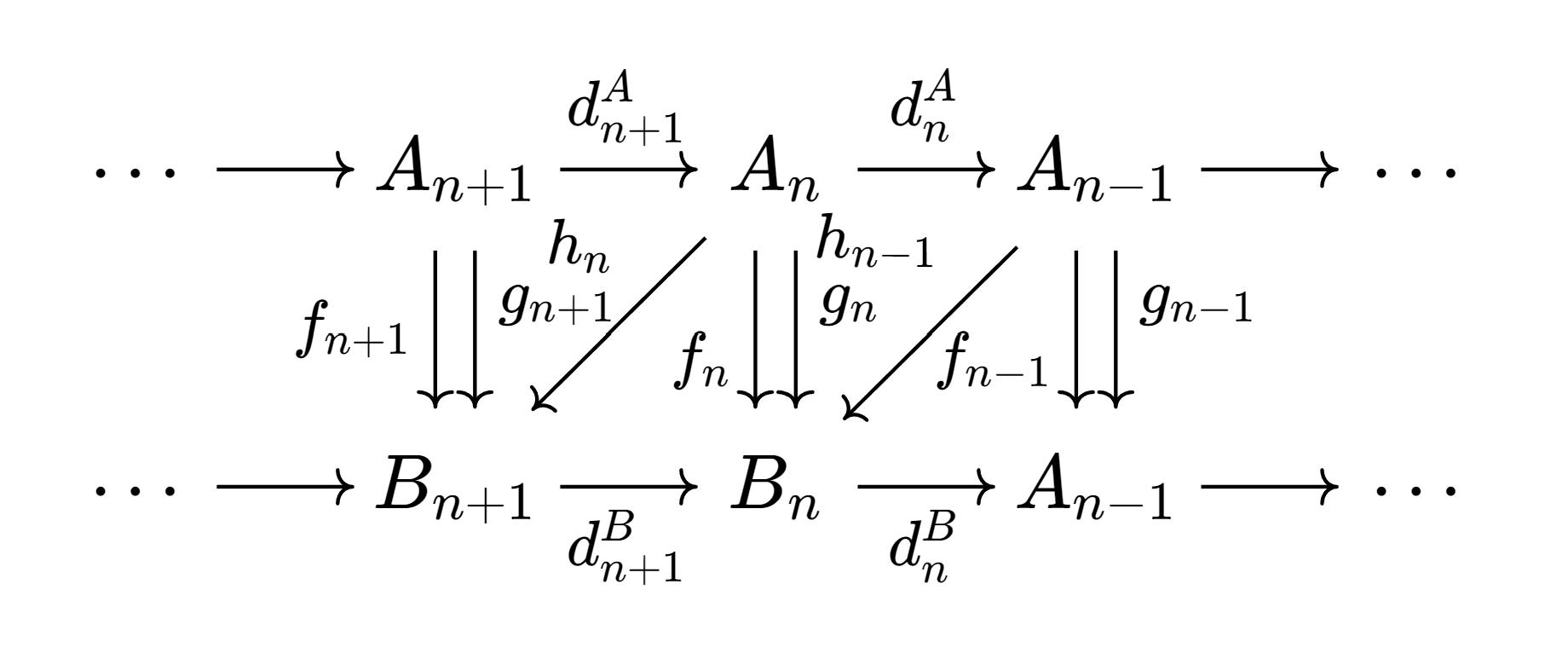
Definition 1. A homotopy h:f→g between two maps f,g:A→B is a family of morphisms hn:An→Bn s.t. the following diagram commutes and fn−gn=dn+1hn+hn−1dn for all n.
We write f≃g.
We give some basic property of homotopy.
Proposition 1. The homotopy relation is an equivalence.
Proof
Proof.
For tansitivity: If f≃g, g≃h,
fn−gn=dn+1sn+sn−1dn
gn−hn=dn+1tn+tn−1dn
So fn−gn=dn+1(sn+tn)+(sn−1+tn−1)dn i.e. f≃h.
For symmetric: If f≃g, $$f_{n}-g_{n}=d_{n+1}h_{n}+h_{n-1}d_{n}\Rightarrow g_{n}-f_{n}=d_{n+1}(-h_{n})+(-h_{n-1})d_{n}$$
For reflectivity: Obvious. ◻
Proposition 2. Let f≃g:A→B, f′≃g′:B→C, then f′f≃g′g:A→C.
Proof
Proof. Let fn−gn=dn+1hn+hn−1dn and fn′−gn′=dn+1hn′+hn−1′dn. Then
Thus gn′fn≃gn′gn and fn′fn≃gn′fn, so fn′fn≃gn′gn. ◻
Proposition 3. Let F:Ch(A)→Ch(A) be an addictive functor. If f≃g:A→B, then Ff≃Fg:FA→FB.
Proof
Proof. Let h:f→g. Then we have $$\begin{aligned}Ff_{n}-Fg_{n}&=F(d_{n+1}h_{n}+h_{n-1}d_{n})\\&= F(d_{n+1})F(h_{n})+F(h_{n-1})F(d_{n})\end{aligned}$$ So Ff≃Fg. ◻
Homotopy and homology functor
The homotopic morphisms will induce the same morphism under homology functor H(−).
Theorem 1. For f≃g:A→B with h:f→g, we have H(f)≃H(g).
Proof
Proof. $$\begin{aligned}\mathrm{Im}(f-g)&=(f-g)(\mathrm{Ker}d_{n})\\&=d_{n+1}h_{n}(\mathrm{Ker}d_{n})+h_{n-1}d_{n}(\mathrm{Ker}d_{n})\\&=d_{n+1}h_{n}(\mathrm{Ker}d_{n})\subset\mathrm{Im}d_{n+1}\end{aligned}$$ So H(f−g)=0, i.e. H(f)=H(g). ◻
There’s an example f≃g but H(f)=H(g).
Take the chain complex
Let f0=id:Z→Z and gn≡0, we have Hn(f)=Hn(g)=0 since H0(A)=Z2 and H0(B)=Z.
However, f≃g, to see this, we tensor Z2 on A and B as Z module.
H0(A⊗Z2)≅Z2 and H0(B⊗Z2)≅Z2, H0(f⊗id)=1 but H(g⊗Z2)=0. From Proposition 3 above, f and g cannot be homotopic.